What the pipe is used for
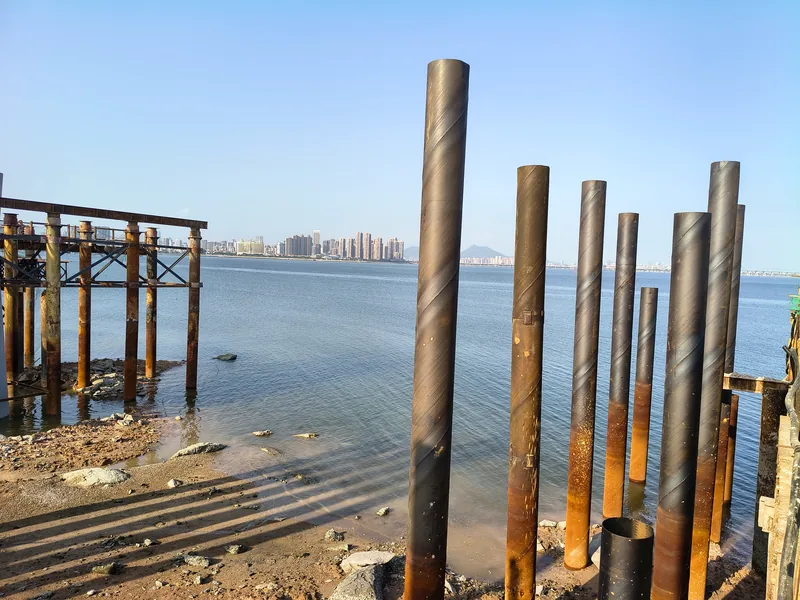
On a water crossing, the pile is the part that has to survive. Spiral welded pipe gives a continuous weld along the full length with a consistent wall thickness, which makes it suitable for driven piles, bored pile casing and the legs of a temporary trestle.
We supply it as a standalone item, or cut and prepared to match a pile layout drawing — including splice lengths, stiffener rings and lifting lugs where the contractor needs them.
Where it goes
- Bridge pile foundations — driven or bored, permanent or temporary casing
- Marine trestle and working platform legs — with bolted or welded connections above water level
- Cofferdam and retaining works — sheet pile walings, struts and corner sections
- Drainage and outfall — large diameter pipe with bell-and-spigot or welded joints
Specification
| Outside diameter | Ø219 – Ø3,000 mm (8" – 118") |
| Wall thickness | 6 – 25 mm |
| Length | 6 – 12 m standard; up to 18 m by arrangement |
| Steel grade | Q235B, Q355B, L245 – L360, API 5L Gr.B – X65 |
| Welding | Double-sided submerged-arc welding (SAW), spiral seam |
| Standards (China) | GB/T 9711-2017, SY/T 5037-2018 |
| Standards (US) | API 5L, ASTM A252 (pipe piles), ASTM A53 |
| End preparation | Plain, 30° bevel, flange, socket / spigot, welded cap |
| Surface | Shop primer, epoxy, polyurethane, 3PE, cement lining |
| Inspection | UT or RT on the seam, hydrostatic test, dimensional check |
| Documentation | Mill test certificate, weld report, coating thickness record |
Grade equivalents: Q235B / ASTM A36 · Q355B / ASTM A572 Gr.50 · L245–L360 / API 5L Gr.B–X65.
End details we prepare
The end of the pipe decides how it behaves on site. We can supply four common preparations:
- Bevelled — for field butt welding, with the bevel angle and root gap agreed on the drawing
- Flanged — welded flange with a drilled bolt pattern to suit the connecting member
- Socket and spigot — for quick jointing of casing and drainage pipe
- Driving shoe — a welded shoe or cutting edge for rock-socketed piles
Coating for coastal sites
Salt air and tidal zone exposure need more than a shop primer. For marine crossings we normally recommend an epoxy system at 250–300 µm total dry film, or 3PE where the pipe will be handled roughly during driving. Hot-dip galvanising is available on smaller diameters.
If the pipe is permanent casing in a chloride environment, tell us at enquiry stage — the coating system and the extra thickness allowance change the price materially, and it is cheaper to decide before rolling than after.
Questions we get
Can you cut to a pile schedule?
Yes. Send the pile layout with lengths, toe levels and any splice positions, and we return a cutting list for approval before production.
Do you supply test certificates?
Every bundle ships with the mill certificate for the coil, the weld inspection report and the dimensional record. Third-party inspection can be arranged on request.
What is the minimum order?
A single 20 ft container is workable for standard diameters. Below that, the fixed cost of set-up and coating tends to dominate the price.
Send the pile layout, get a cutting list and a price.
Lengths, toe levels, splice positions and coating system are all we need to start.