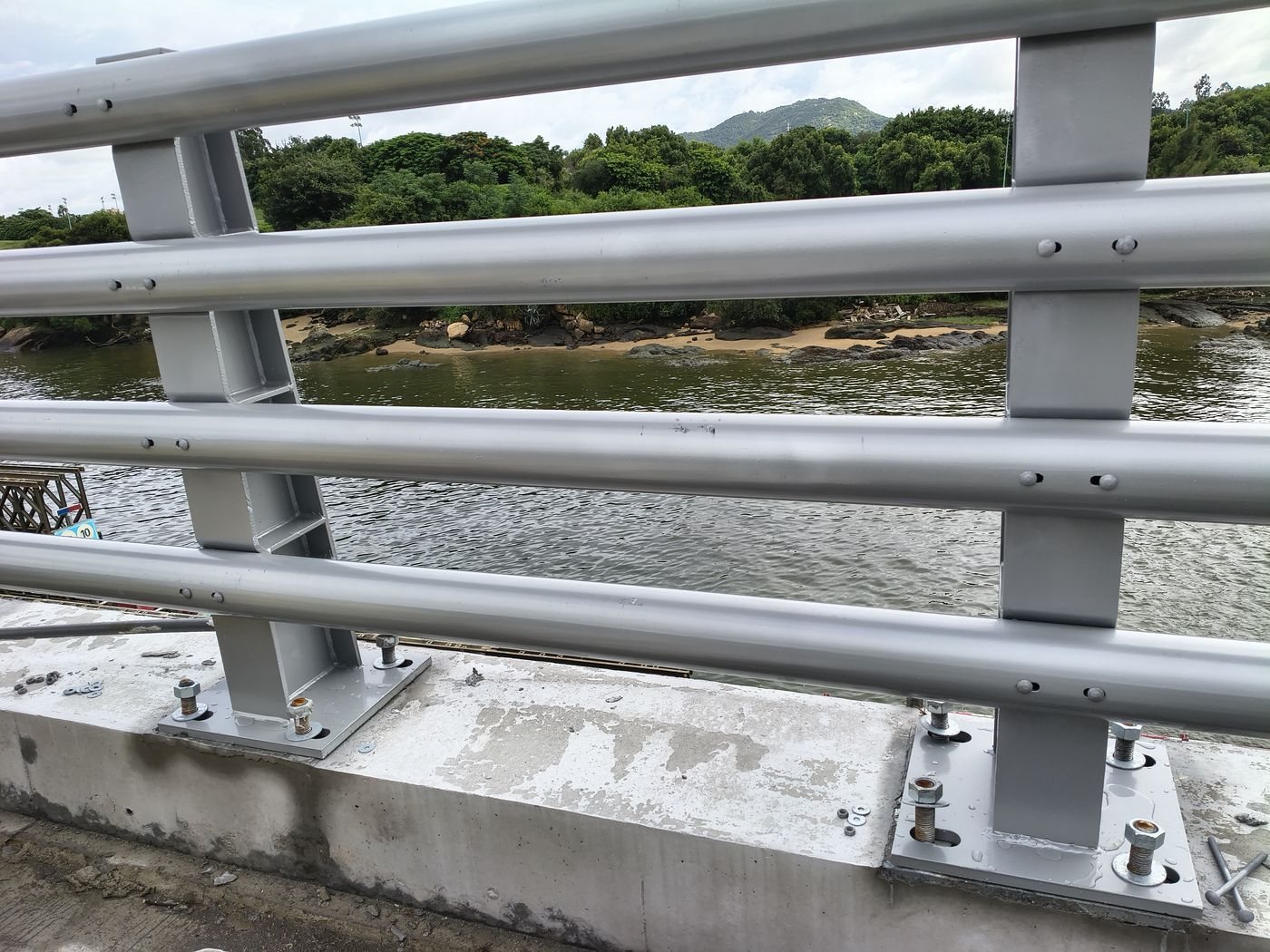
On a marine crossing, “galvanised” is not a specification — it is a starting point. What decides service life is the coating thickness, the surface it was applied to, and whether the site repairs were done with a compatible system.
Why 85 µm
Hot-dip galvanising protects steel in two ways: it seals the surface, and it sacrifices itself at scratches. In a salt-air environment the sacrificial reserve is what keeps a scratched rail from rusting through. Specifying a minimum mean thickness — 85 µm is a common coastal requirement — buys time at exactly the places coatings fail first: cut ends, drilled holes and weld spatter.
Confirm the requirement against the project specification and the applicable standard (ISO 1461 is the usual reference for hot-dip galvanising). If the spec calls for a duplex system, the galvanising is a primer for a topcoat, not the finish.
Surface preparation decides the number on the gauge
A thickness reading can be correct and the coating still fail, because thickness says nothing about adhesion. Shot blasting to Sa 2.5 before priming, and proper fluxing before dipping, are what make the number meaningful.
For fabricated assemblies, the details matter more than the average: vent and drain holes so molten zinc can escape and air can leave, no overlapping plates that trap acid, and welds dressed so they do not hold water.
Duplex systems: when a topcoat earns its cost
Duplex — galvanising plus a paint system — is usually specified where appearance matters, where the steel sits in the splash zone, or where the design life is long. The topcoat slows the consumption of the zinc and gives a colour that can be maintained. The trade-off is that the paint must be compatible with the galvanised surface, and the site repair procedure becomes two-step.
What to inspect before shipment
- Coating thickness readings per bundle, not per project average
- Visual check for bare patches, dross, and blocked holes
- Adhesion check on a sample if a duplex system is specified
- Threaded components: tapped or re-cut after dipping, with a gauge check
- Touch-up compound on cut ends and site-drilled holes, packed with the bundle
The site phase is part of the coating system
Every site weld and every drilled hole is a breach. A zinc-rich touch-up applied the same week is very different from one applied after a month of salt spray. Put the touch-up material in the same shipment as the steel, and write the procedure into the erection method statement.
That is the unglamorous part of coastal work, and it is the part that decides whether the barrier still looks like a barrier after five winters.
Related notes
Working on something similar?
Send the drawing and the port. We reply with an itemised quotation and a preliminary loading plan.
Request a quoteSee the package behind this note.
The Haicang Aoguan crossing, photographed from the pile heads to the barrier line.