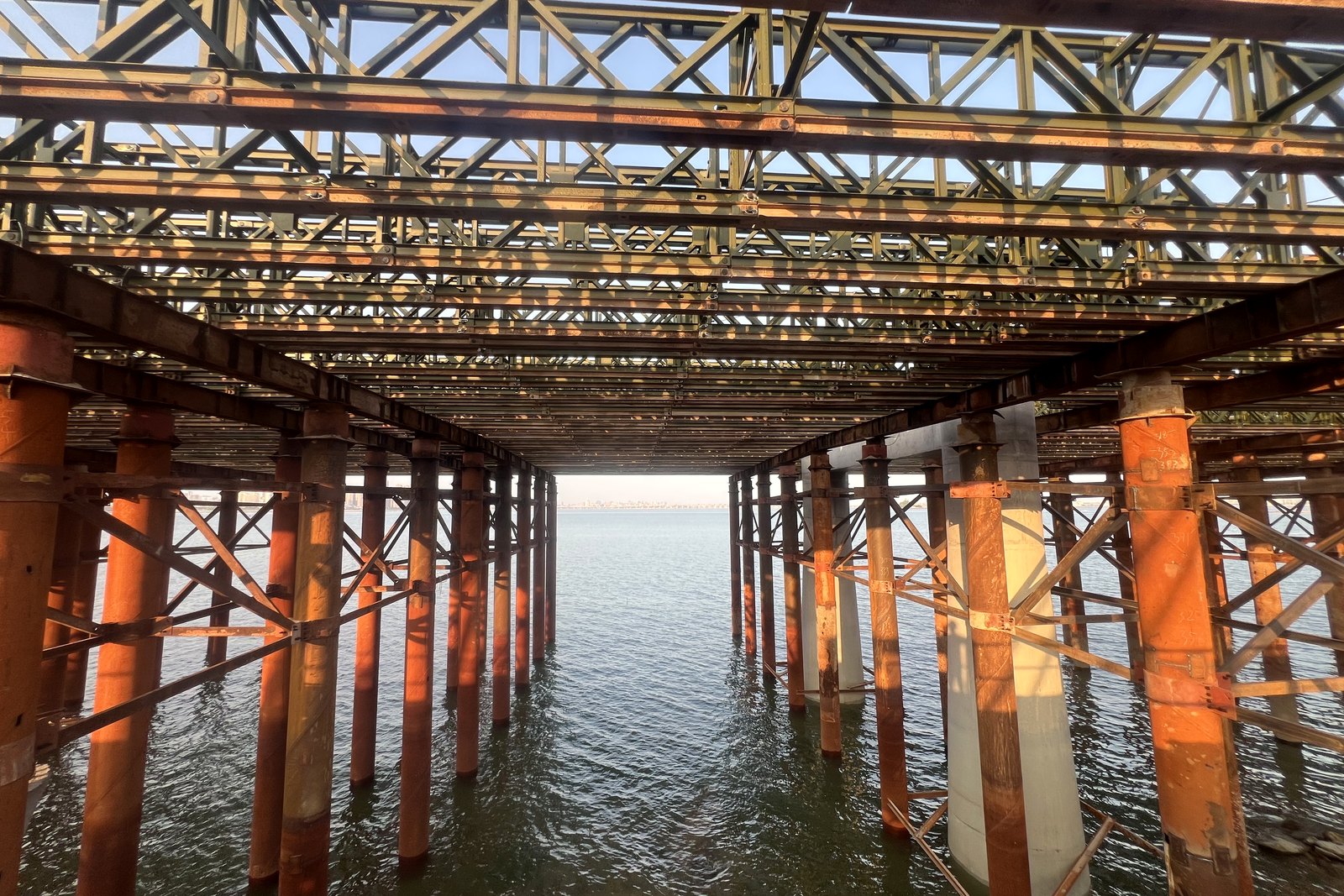
When a deck is poured over a tidal bay, the falsework is not a temporary accessory — it is the working level, the survey datum and the safety system for everyone on the deck. These are the five details we return to on every package.
1. The pile-head level is the tolerance you cannot recover
Every bent starts with a group of piles. Whatever level those pile heads finish at becomes the datum for the capping steel, the trusses and the formwork above it. If the heads are out, the error has to be absorbed by jacking, packing or worse — by cutting and re-welding on a platform above moving water.
The practical answer is to fabricate the pile-head steel with an allowance for adjustment, and to survey each head before the cap is set. On a repeated crossing this also means the cap becomes a repeatable part rather than a one-off fabrication, which is what keeps the erection crew moving.
2. Truss layout follows the pour sequence, not the drawing grid
Bailey trusses are usually drawn as a regular grid because that is how they are calculated. On site the deck is poured in segments, and the load moves as each segment gains strength. A layout that ignores the pour sequence can leave one bent carrying a load it was never checked for during the critical hour.
We ask for the pour sequence with the drawings. It changes transom spacing and sometimes the number of truss lines, and it is much cheaper to resolve in the shop than on the trestle.
3. Edge protection belongs inside the falsework package
The edge of a deck over water is where the risk concentrates: formwork fixing, rebar tying, pouring and striking all happen within a metre of a drop. Toe boards, mesh panels and guardrail posts are often bought separately — and then improvised on site.
Putting them in the same bill of materials as the falsework means the posts have a designed fixing, the mesh has the right panel size, and nothing waits for a late delivery while the deck is open.
4. Coating and fixings decide the second life
Temporary steel is reused. On a coastal site it is also wet, salty and often stored outside between projects. Hot-dip galvanising to 85 µm, or a duplex system on exposed edges, is what allows the same trusses to go to the next crossing instead of the scrap bin.
The fixings matter as much as the coating: galvanised pins, stainless or sheradised bolts, and drainage holes so water does not sit inside a chord.
5. The striking sequence has to be designed in
Getting the falsework out is harder than getting it in, because by then the deck is above it. Jacking points, drop-heads and the order in which trusses are released should be on the drawing, not decided by the crew at 6 a.m.
On marine sites we also plan for tide windows: a truss that can be released and lifted in one piece is worth more than one that has to be cut apart.
What to send with an enquiry
- General arrangement and soffit drawing, with deck levels
- Pour sequence and maximum segment load
- Pile layout, diameter and expected head level
- Access method: crane from the trestle, barge, or launch
- Exposure category and required coating system
With those five items we can price a package that includes the steel, the accessories and the edge protection — and flag the details that would otherwise surface on site.
Related notes
Working on something similar?
Send the drawing and the port. We reply with an itemised quotation and a preliminary loading plan.
Request a quoteSee the package behind this note.
The Haicang Aoguan crossing, photographed from the pile heads to the barrier line.